How to Design Perfect Lighting for your Home
This blog explains how to choose the right lighting for every room using the ideal Kelvin (color temperature) and lumen (brightness) levels. Learn which lighting works best for living rooms, bedrooms, kitchens, and more to create the perfect balance of comfort, functionality, and modern home design.
INTERIOR DESIGN
Understanding Lumens (Brightness)
Lumens measure how bright a light is. The required brightness depends on the size and purpose of the room.
Low lighting: Comfortable & relaxing
Medium lighting: Balanced everyday use
High lighting: Task-focused & functional
Introduction
Lighting is one of the most important elements in home interior design. It not only enhances the beauty of your space but also affects mood, comfort, and functionality. Choosing the right lighting involves understanding color temperature (Kelvin) and brightness (lumens) for each room. In this guide, we will help you design the perfect lighting setup for your home by selecting the right Kelvin range and the correct amount of light required for every space.
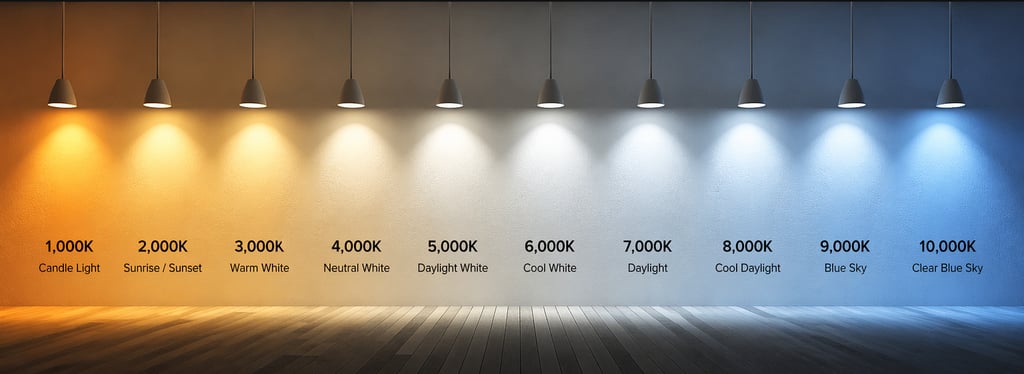
Understanding Kelvin (Color Temperature)
Kelvin (K) defines the color appearance of light:
2700K–3000K (Warm White): Cozy, relaxing – best for bedrooms & living rooms
3500K–4100K (Neutral White): Balanced, natural – ideal for kitchens & work areas
5000K–6500K (Cool White): Bright, energetic – suitable for bathrooms & study rooms
Choosing the right Kelvin helps create the right mood in each room.
-----------------------------------------------------------------------------------------------------------------------------------------------------------------
Lumen Calculation Per Square Foot (Lighting Guide)
To design the right lighting for your home, you need to calculate
how much light (lumens) is required based on room size.
This is done using a simple formula:
Required Lumens = Room Area (sq.ft) × Lumens per sq.ft
Recommended Lumens per sq.ft by Room Type:
Living Room: 10–20 lumens/sq.ft
Bedroom: 10–20 lumens/sq.ft
Kitchen: 30–40 lumens/sq.ft
Bathroom: 30–40 lumens/sq.ft
Study Room: 40–50 lumens/sq.ft
Dining Area: 20–30 lumens/sq.ft
Example Calculation:
If your living room is 150 sq.ft:
150 × 15 lumens = 2250 lumens required
This helps you choose the right number of lights and brightness for a well-lit and comfortable home.
-----------------------------------------------------------------------------------------------------------------------------------------------------------------
Pro Tip: Wall color matters! If you have dark walls or heavy wood paneling, you may need to increase your lumen count by about 20% because dark surfaces absorb light rather than reflecting it.
Ambient Lighting (General Lighting)
This is the main source of light in a room. It provides overall brightness and ensures the space is well-lit for everyday use. Examples include ceiling lights, chandeliers, and recessed lights.
Task Lighting (Functional Lighting)
Task lighting is focused lighting used for specific activities like reading, cooking, or working. It improves visibility and reduces eye strain. Examples include study lamps, under-cabinet lights, and mirror lights.
Accent Lighting (Highlight Lighting)
Accent lighting is used to highlight specific features in a room such as artwork, textures, walls, or décor elements. It adds depth and visual interest. Examples include spotlights, wall washers, and track lights.
Decorative Lighting (Aesthetic Lighting)
Decorative lighting is mainly used for style and design. It enhances the overall look of the space and acts as a visual element. Examples include pendant lights, designer fixtures, and LED strips.
Layers of Lighting
A well-designed home uses three main layers of lighting to create balance and functionality. Ambient lighting provides overall illumination for the entire room. Task lighting focuses on specific activities like reading, cooking, or working. Accent lighting highlights design elements such as wall textures, artwork, or décor. Decorative lighting adds style and visual appeal, acting as a design feature.
Combining these layers helps create a space that is both practical and aesthetically pleasing.
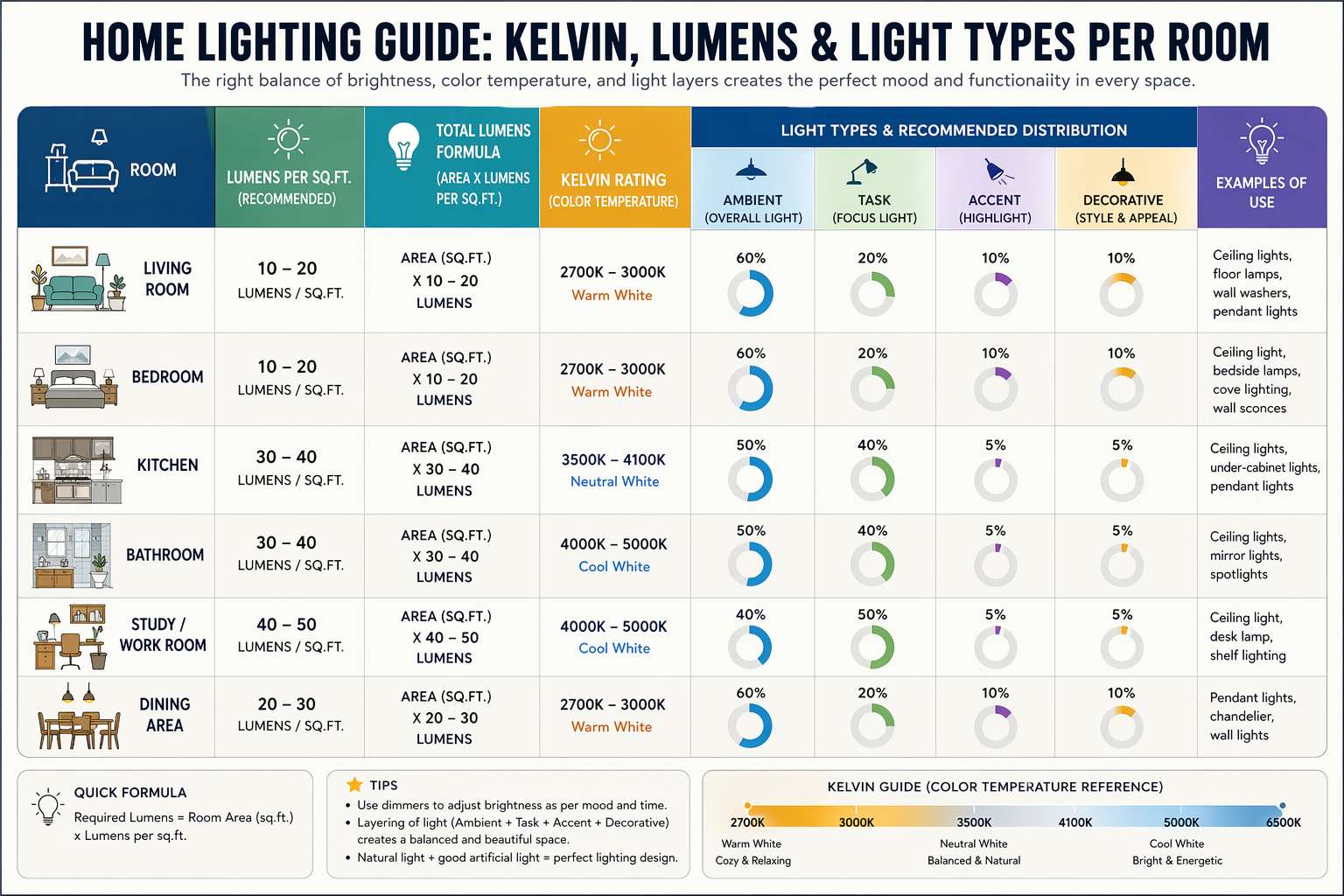
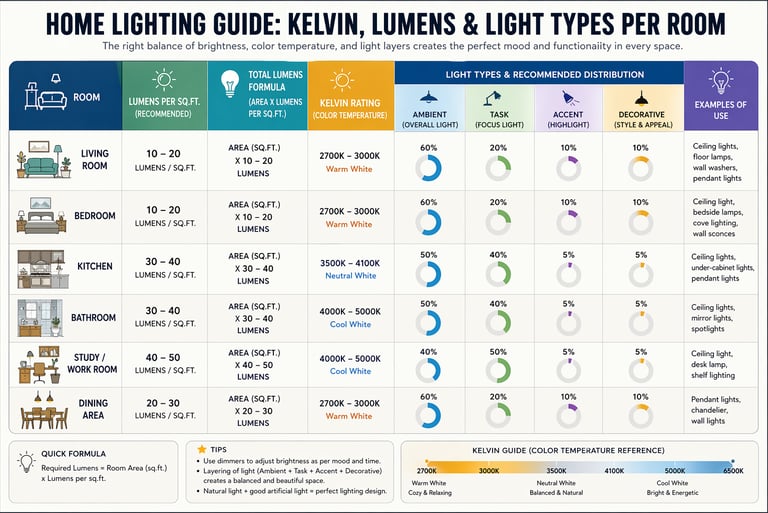
Home Lighting Guide Chart
This chart provides a complete overview of how to design lighting for each room in your home by combining the right lumens (brightness), Kelvin (color temperature), and lighting layers. It helps you understand how much light is required based on room size, what color temperature suits each space, and how to balance ambient, task, accent, and decorative lighting for the best results.
By following this chart, you can create a well-lit home that is both functional and visually appealing, ensuring the right mood and efficiency in every room.
Living Room
Ambient: Place ceiling lights or recessed lights evenly across the room for uniform brightness
Task: Add floor lamps or table lamps near sofas and reading areas
Accent: Use wall lights or spotlights to highlight TV units, textures, or artwork
Decorative: Install a chandelier or pendant light as a focal point
Bedroom
Ambient: Soft ceiling light or cove lighting for a relaxing feel
Task: Bedside lamps or wall-mounted reading lights on both sides of the bed
Accent: LED strips behind headboard or false ceiling for depth
Decorative: Pendant lights or designer fixtures for aesthetic appeal
Kitchen
Ambient: Bright ceiling lights or panel lights for overall visibility
Task: Under-cabinet lights for countertops and cooking areas
Accent: Spotlights for backsplash or open shelves
Decorative: Pendant lights above island or dining counter
Bathroom
Ambient: Ceiling-mounted bright light for general illumination
Task: Mirror lights or side lights for grooming
Accent: Soft LED strips in niches or under vanity
Decorative: Minimal fixtures to maintain a clean look
Study / Work Room
Ambient: Even ceiling lighting to reduce shadows
Task: Desk lamp focused on work area
Accent: Shelf lighting or wall highlights
Decorative: Keep minimal for distraction-free environment
Dining Area
Ambient: Soft ceiling lighting for overall comfort
Task: Pendant light directly above dining table
Accent: Wall lights or spotlight on décor
Decorative: Statement chandelier to enhance ambiance
Placement of Lighting Layers in Each Room
Designing lighting is not just about choosing fixtures—it’s about placing each layer correctly to achieve balance, comfort, and functionality.Placement of Lighting Layers in Each Room
Designing lighting is not just about choosing fixtures—it’s about placing each layer correctly to achieve balance, comfort, and functionality.
Pro Tips
Always layer lighting—don’t rely on a single source
Maintain proper spacing between lights for even distribution
Use dimmers to control mood and brightness
Combine function with aesthetics for best results
-----------------------------------------------------------------------------------------------------------------------------------------------------------------




-----------------------------------------------------------------------------------------------------------------------------------------------------------------
-----------------------------------------------------------------------------------------------------------------------------------------------------------------
No : 56 karuneegar street Thiruninravur 602024
+91 8072349457 / 9677287622
info.homelifeproperties369@gmail.com